
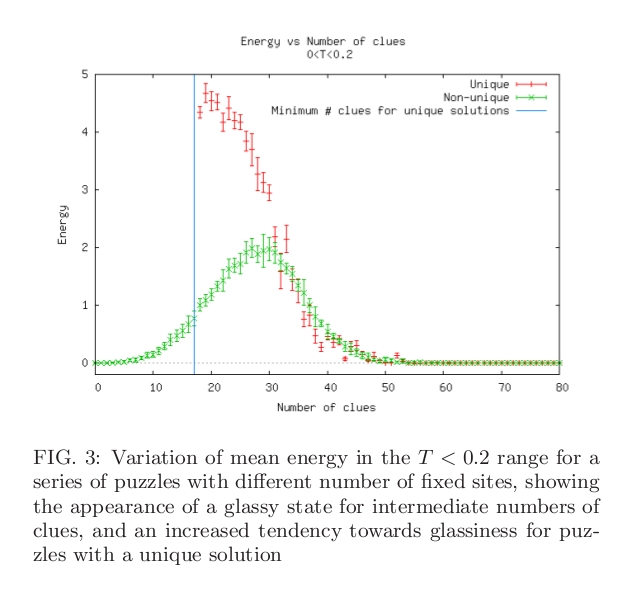
The paper http://arxiv.org/abs/1212.1649 has some interesting things to say about the physics of Sudoku. What? The physics of Sudoku? Isn’t that the puzzle with the 9 by 9 grid of numbers? Yes, but if you look at it in the right way, by introducing deliberate mistakes into the puzzle, you can interpret all this as a physical system with a Hamiltonian, exhibiting three phases: condensed, paramagnetic, and glass.
The condensed state is the one that solves the puzzle, but the authors are quick to point out that this is not the purpose of the study! The term glass refers to a brittle state that can be transformed into a molten, rubbery state, and the term paramagnetic usually refers to a material that is attracted by an external magnetic field, but does not retain any magnetization in the absence of the field.
The Sudoku model is remarkable because there are relatively few simple models for frustrated or glassy systems which exhibit both “ordering” and “glass” transitions. The unique solution of a Sudoku puzzle makes it a remarkably strong glass former.
These results initially sound surreal, but they have been published in the journal Physical Review E: http://pre.aps.org/abstract/PRE/v86/i3/e031109
#physics #statisticalmechanics #scienceeveryday
 A Pun Involving Travel
Try KenKen?
LikeLike
❤ KenKen. Know of any others?
LikeLike