
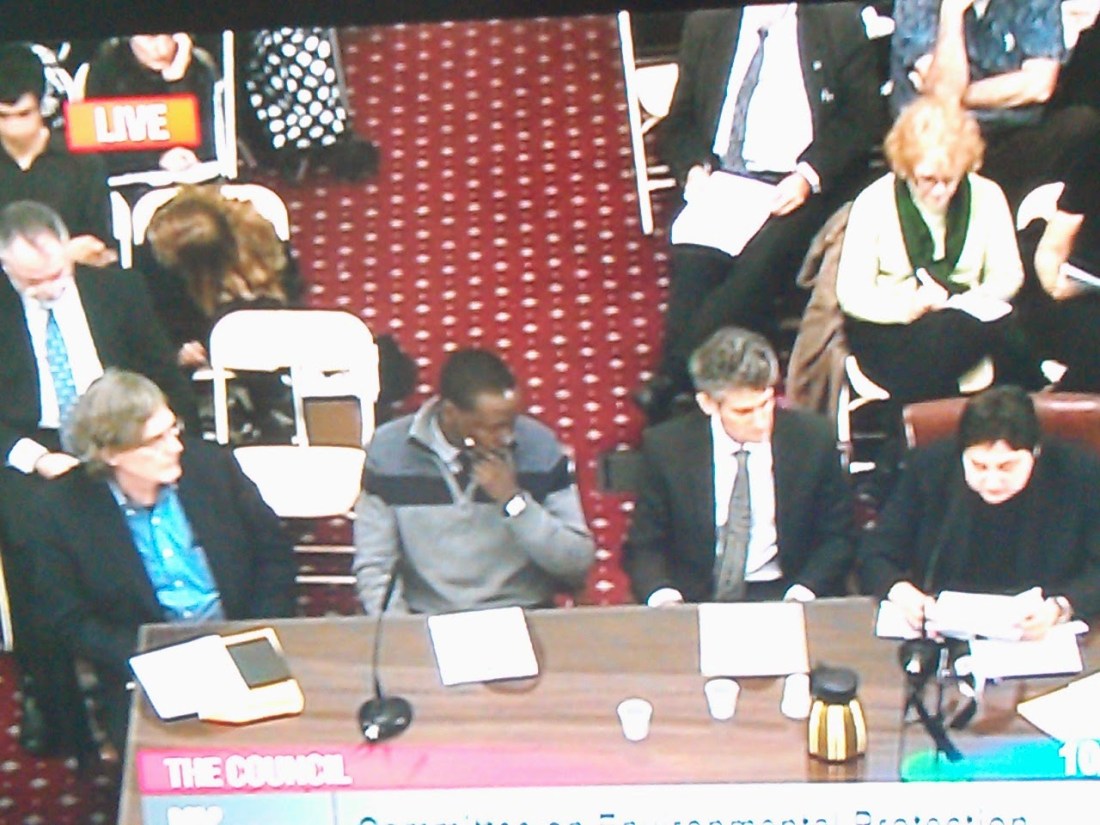
I testified today before the New York CIty Council on Int. No. 738-2014 which calls for New York City to adopt the goal of reducing carbon emissions 80% by 2050. (i.e. 80×50).
What follows are the notes I used in making my comments. What I actually said followed the same general structure and content but with different words.
The 80×50 target is a good start, but we must consider several implications that aren’t well explored in the Mayor’s Plan:
Cleaner systems are typically cheaper when total cost of ownership (TCOE) is considered. Thus, 80×50 makes sense even if the climate change deniers are right and CO2 emissions aren’t important. Because cleaner is cheaper, we should target 80% reduction sooner than 2050.
Efficiency: The cleanest and cheapest energy is the energy you don’t buy or use. Efficiency can often have high up-front costs but pays off through lower energy and operating costs.
Thermal Energy: We focus electrical energy while ignoring thermal energy even though many buildings dump vast amounts of waste heat. We need to find ways for buildings to sell their excess thermal energy to neighboring buildings. Waste heat could be a profit center!
Fuel Switching: We must replace direct-use of fossil fuels with cheaper electric systems and increase the proportion of energy delivered and consumed as electricity.
2,000,000 vehicles are registered in our city. Most burn fossil fuels and would be both cheaper and cleaner if powered by electricity. Already, total cost of ownership of some electric vehicles is lower than their internal combustion equivalents. Electric vehicle costs will only drop further in the future.
The 1,000,000 buildings in our city are mostly heated with fossil fuels. But, Columbia University researchers estimate that as many as 80% of our buildings, mostly outside Manhattan, could be heated and cooled using often cheaper and always cleaner Ground Source Heat Pumps. Clean heat is cheap heat.
Today, PSC and NYSERDA policy discourages fuel switching!
The Second Great Electrification of our society:
Electricity is the fuel of the future even though it only accounts for one-third of the delivered energy in the US today. It is cleaner and cheaper than direct-use fossil fuels and will get even cleaner and cheaper in the future as renewable energy resources grow.
The First Electrification focused on lighting, communications, and appliances. The Second Great Electrification will focus on the transportation and heating/thermal applications which consume two-thirds of delivered energy in the US today and primarily rely on direct-use of burned, dirty fossil fuels.
While utilities seem focused on losses of market share to distributed generation, they should instead be preparing to double or triple the amount of electricity produced.
A Shift from Operating Expense to Capital Expense will require substantial support through financing programs. More money is needed than can be provided by cash subsidy programs.
Today, you pay for energy at or near the time when you consume it. In the future, you’ll pay more for “capacity” and you’ll pay less or even nothing as you actually consume energy.
Fossil fueled systems offer lower up-front costs, but their operating costs are higher. It is like giving razors away for free and then charging for the blades. Pay-As-You-Go is often more convenient than Pay-Up-Front, but it is much more expensive in the long run.
It takes money to save money. Today, only the relatively wealthy, with good credit, can afford the cheaper, cleaner alternatives. This must change.
The solar industry has proven that large amounts of private capital can be attracted to clean energy technology that delivers good yield.
NYCEEC, NYSERDA and our Capital Markets can profitably provide the financing we need via leases, PPA’s, loans, loan guarantees, bonds, securitization, etc.
Notes:
Some Electric Vehicles are already cheaper than their “same-class” alternatives. For detailed comparison, see 79 in the World Resources Institute paper “Seeing is Believing: Creating a New Climate Economy in the United States,” published October 2014 at: http://www.wri.org/sites/default/files/seeingisbelieving_working_paper.pdf
Heat Pumps are both cleaner and cheaper than fossil fueled heating/cooling systems.
Grid powered heating/cooling systems, particularly ground source heat pumps, are cleaner than fossil fueled systems and usually cheaper. This is particularly true in New York City and Upstate New York since we have some of the cleanest grid-supplied power in the country.
According to the EPA, the New York City/Westchester “sub-grid” delivers power with an average CO2 cost of 300 grams/kWh after transmission losses are considered. Furnaces that burn No. 2 oil at average efficiencies produce thermal energy at a CO2 cost of 324 grams/kWh_t. The CO2 cost for propane is 275 grams/kWh_t and for natural gas it is 221 grams/kWh_t.
Thus, using “clean” New York City grid power, any heating/cooling system that is 90% efficient will produce heat more cleanly than No. 2 oil. Any system with an efficiency of at least 110% will be cleaner than propane and any system with an efficiency of 140% will be cleaner than natural gas.
The EnergyStar minimum efficiency rating for Ground Source Heat Pumps is 310% (i.e. COP=3.1). Thus, any EnergyStar-compliant GSHP in New York City will be much cleaner than an equivalent fossil fueled system. GSHP augments grid-power with locally harvested thermal energy for > 100% efficiency.
Given 2013 New York City power and fuel prices, a ground source heat pump system with a COP = 3.1 would have “fuel” costs of only 53% that of a No. 2 oil burner and 51% of the cost of a propane powered system. At COP=3.1, natural gas would be cheaper. However, if the heat pump ran with an efficiency of 400% (COP=4), which is more typical of current industry standards, the GSHP would be 5% cheaper than the natural gas burner. COP’s will increase in the future.
 A Pun Involving Travel
Nice going man. Hats off!
LikeLike